Why Hot Water Slab Lines Fail More Frequently
In residential plumbing systems across Queen Creek, hot water supply lines fail at more than triple the rate of cold water lines. When homeowners experience a hot water slab leak repair Queen Creek emergency, thermal dynamics and aggressive water chemistry are almost always the underlying culprits.
Whenever hot water is called for at a kitchen sink, washing machine, or bathroom fixture, 120-degree water surges through subterranean copper piping. This rapid temperature change causes the copper metal to expand longitudinally. When the fixture shuts off, the pipe cools and contracts. Over 15 to 25 years in Queen Creek subdivisions, this perpetual cycling causes the pipe to rub abrasively against rocky soil, sand, and sharp caliche stones beneath the slab. Eventually, that friction wears through the outer wall of the tubing, while internal mineral deposits erode the inner wall.
Key Symptoms: Detecting a Hot Line Breach
A compromised subterranean hot water line exhibits unmistakable physical and economic symptoms:
- Warm Spot on the Floor: A warm spot on floor Queen Creek residents discover while barefoot in a hallway, bathroom, or kitchen is the single most common symptom. Heat conducts upward through the concrete slab, heating tile, laminate, or carpet above.
- Water Heater Running Constantly: Hearing your water heater running constantly Queen Creek homes experience indicates that hot water is continuously escaping out of the pressurized pipe into the ground, forcing the tank to fire continuously.
- Surging Gas or Electric Utility Bills: Because the burner or heating elements run 24 hours a day to replace escaping heated water, energy bills spike dramatically even if water loss is moderate.
- Rapid Depletion of Domestic Hot Water: Showers turning lukewarm within minutes because a substantial portion of the tank capacity is bleeding into the subterranean soil.
- Audible Hissing Near the Water Heater: Hearing a steady fluid hiss at the water heater supply lines or expansion tank when no faucets are in active use.
Water Heater Firing Continuously?
A hot water line leak under slab Queen Creek properties suffer wastes immense energy and stresses your water heater tank. Shut off the cold intake valve above your heater and call our dispatch line.
How Hot Water Leaks Are Located With Thermal Imaging
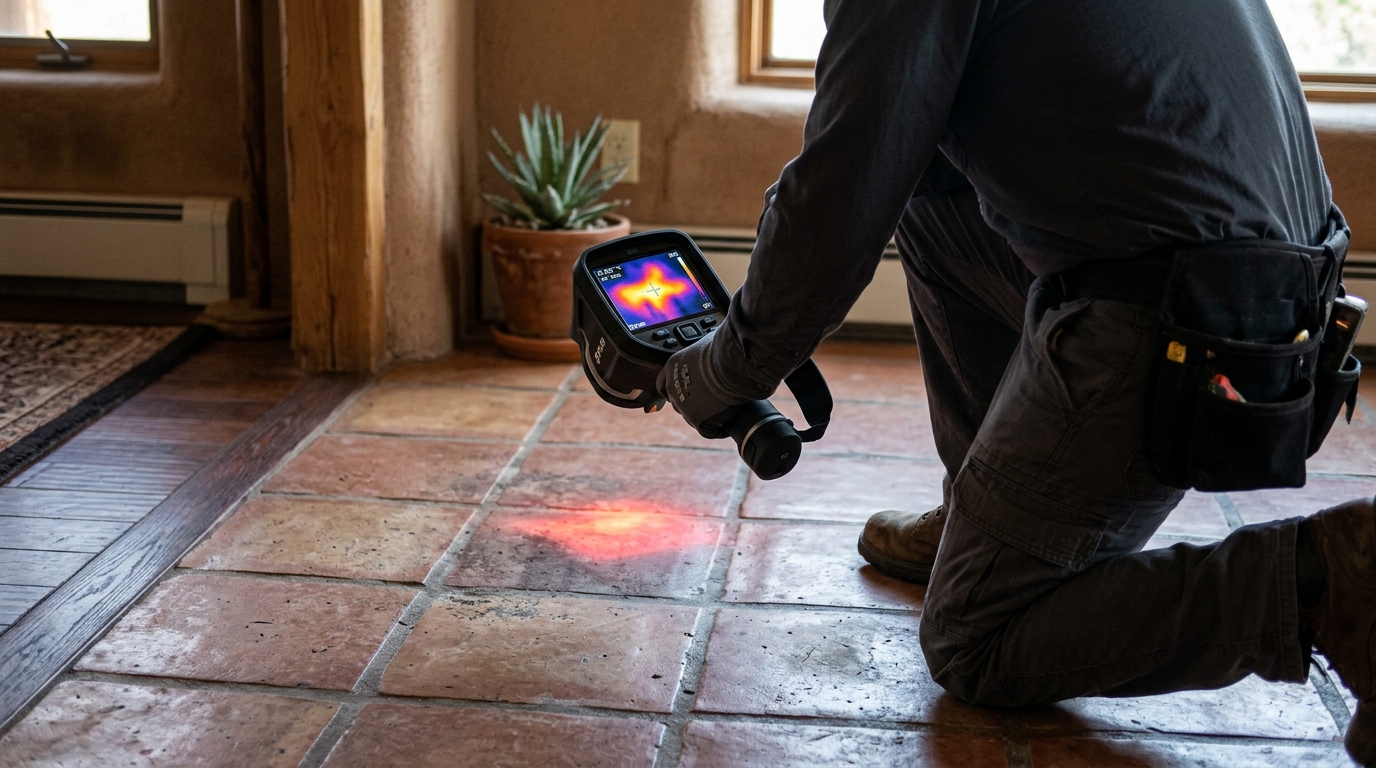
Locating a hot line breach is significantly aided by modern infrared thermography. When pressurized 120-degree water discharges beneath concrete, it creates a expanding thermal heat plume that transfers upward into the slab mass.
Our technicians use high-sensitivity radiometric thermal cameras calibrated to detect tenth-of-a-degree temperature variations across floor surfaces. In the infrared viewfinder, the subterranean leak presents as a vivid radiant bloom, showing the point of highest heat concentration. Once verified with acoustic listening disks, we confirm the exact breach coordinate without touching the floor with tools.
Repair vs. Reroute for the Hot Water Loop
Once a hot water line breach is verified, homeowners must choose between two distinct repair paths:
- Direct Concrete Spot Repair: Technicians saw-cut an isolated opening through flooring and concrete, excavate sub-slab gravel, cut out the eroded copper section, and braze in new piping with protective sleeving. While viable for young piping, spot repairs on older copper frequently fail again nearby because the entire run has thinned from thermal cycling.
- Overhead Hot Water Reroute: Technicians disconnect the compromised subterranean hot line entirely at the manifold or water heater, capping both ends beneath the slab. A new commercial-grade PEX line is installed up through the utility wall, across the attic space, and down into the fixture destination. This permanently takes the line out of the subterranean environment and eliminates future slab failures on that branch.
Learn more about our dedicated slab leak reroute methodology or review comprehensive slab leak repair in Queen Creek on our homepage. If hot and cold lines are both demonstrating systemic thinning, exploring full whole-house repiping is often recommended.
Preventing Secondary Water Heater Failure
Continuous hot water leaks place immense mechanical stress on water heaters. Gas burners operate continuously, deteriorating tank liners, while electric elements burn out prematurely. During our diagnostic service, we inspect your water heater's pressure relief valve, expansion tank, and shutoff valves to ensure your entire hot water production system remains safe and operational.
Schedule Hot Water Slab Inspection
Stop high gas bills and protecting your foundation from hot water erosion. Call now to speak with our diagnostic team.